
Request Time Off Form
A clear time-off request form saves managers and staff from confusion about who is away and when. This pack gives you editable request forms — a one-page quick version and a detailed version with coverage and handover — plus a manager approval log, a team leave calendar and an Excel tracker that works out accrued, used and remaining leave for each employee.
- Instant download
- Editable Word & Excel
- Print-ready PDF
- 7-day refund
6 files · DOCX, PDF, XLSX
Time Off Request Form Pack
Editable quick and detailed time-off request forms, a manager approval log, a team leave calendar, an Excel PTO balance tracker with accrual and a policy summary template.
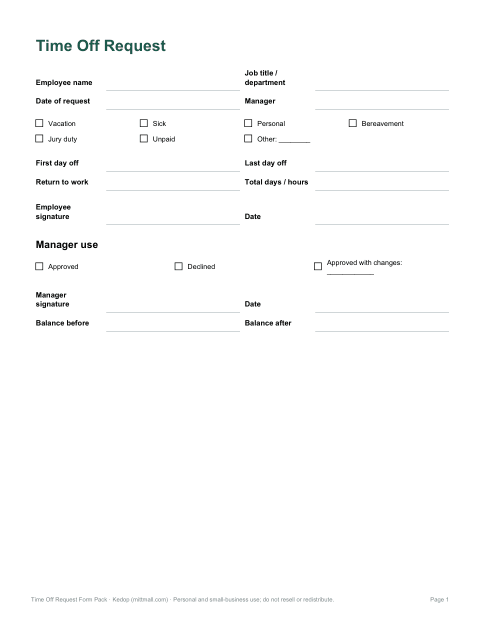
- Quick request form (DOCX/PDF)
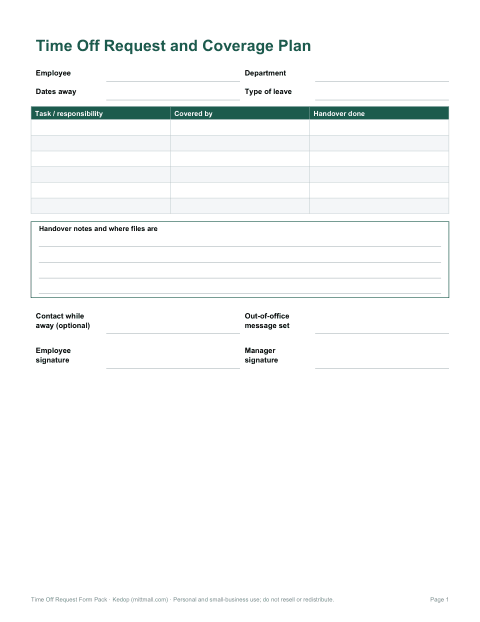
- Detailed form (DOCX/PDF)
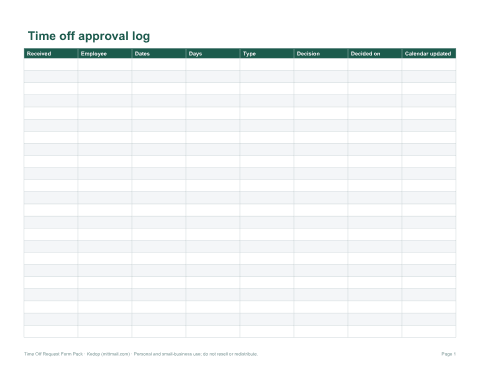
- Approval log (PDF/DOCX/XLSX)
- + 3 more
$5.00 USD, one-time 6 files · about $0.83 each
- Instant download
- 7-day refund
- Secure checkout by Stripe
7-day money-back guarantee. Full refund within 7 days of purchase, even after you download.
Free sample: Quick Time Off Request (PDF, 55 KB)
Time Off Request Form Pack
Editable quick and detailed time-off request forms, a manager approval log, a team leave calendar, an Excel PTO balance tracker with accrual and a policy summary template.
- Quick request form (DOCX/PDF)
- Detailed form (DOCX/PDF)
- Approval log (PDF/DOCX/XLSX)
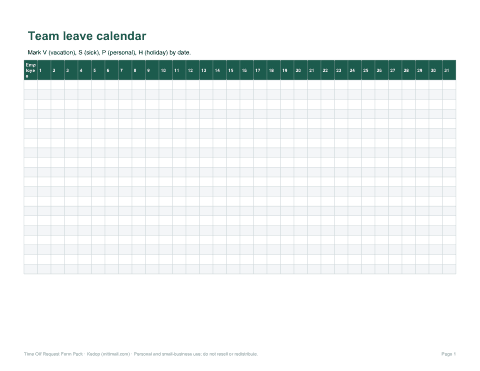
- Leave calendar (XLSX)
- PTO tracker (XLSX)
- Policy summary (DOCX/PDF)
Formats: DOCX, PDF, XLSX. Instant download after payment (link valid 72 hours, up to 5 downloads). AI-assisted: the templates were drafted with AI help and reviewed and laid out before publishing.
$5.00 USD, one-time 6 files · about $0.83 each
- Instant download
- 7-day refund
- Secure checkout by Stripe
7-day money-back guarantee. Full refund within 7 days of purchase, even after you download.
Free sample: Quick Time Off Request (PDF, 55 KB)
Full refund within 7 days — see the refund policy and license.
Free printables
Single sheets you can print right now, no sign-up. The full pack adds every sheet in one download plus the editable files.
 Printable Time Off Request Form
 Printable Time Off Request and Coverage Form
 Printable Time Off Approval Log
 Printable Leave Calendar
 Printable PTO Balance Tracker
 Printable Time Off Policy Summary
Forms in the pack
| Template | What it is for |
|---|---|
| Quick PTO request form | Employee, dates, type of leave, hours, signatures — one page |
| Detailed request with coverage | Adds who covers each task, handover notes and contact while away |
| Manager approval log | Every request, decision and date in one list |
| Team leave calendar | See overlaps and blackout dates at a glance |
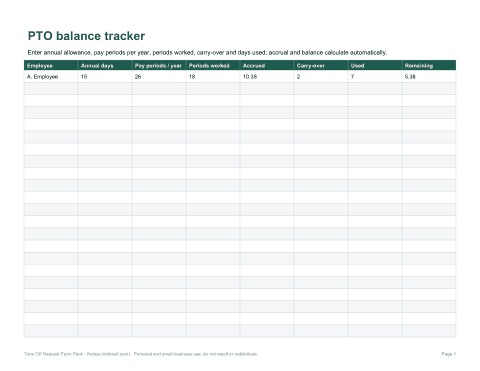
| PTO balance tracker (Excel) | Accrual per pay period, days used and remaining balance |
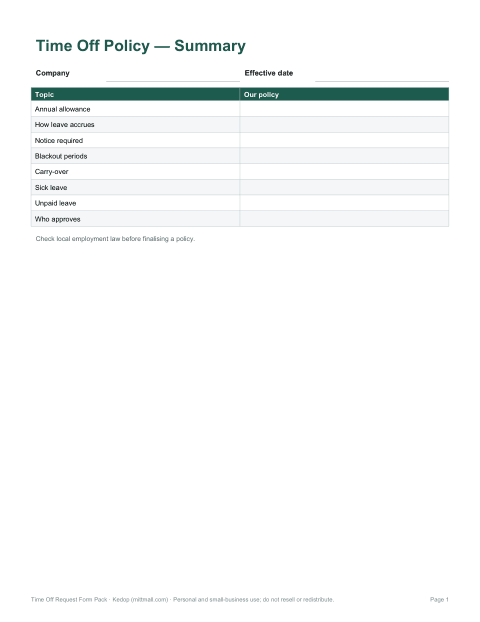
| Time-off policy summary template | A one-page summary to give employees |
What a time-off request form should include
- Employee name, job title and department.
- Type of leave: vacation, sick, personal, bereavement, jury duty, unpaid, other.
- First and last day away and the date of return.
- Total days or hours requested, and whether any are half days.
- Who will cover urgent work.
- Employee signature and date of request.
- Manager decision (approved / declined / approved with changes), signature and date.
- HR note of the balance before and after.
A simple approval process
- The employee checks their balance and the team calendar.
- They submit the form a set time in advance — many workplaces ask for two to four weeks for vacation.
- The manager checks coverage and any blackout dates.
- The manager approves, declines or suggests other dates, in writing.
- The approved dates go on the team calendar and the balance is updated.
- The employee sets an out-of-office message and completes handover.
How PTO accrual works
Many employers let paid time off build up (accrue) over the year instead of granting it all on day one. A common method spreads the annual allowance across pay periods: 15 days a year paid over 26 fortnightly pay periods is 15 ÷ 26 ≈ 0.58 days per pay period, or about 4.6 hours for an 8-hour day. The Excel tracker calculates this automatically from the annual allowance and number of pay periods, then subtracts days used to show the remaining balance.
Worked example
| Item | Value |
|---|---|
| Annual allowance | 15 days |
| Pay periods per year | 26 |
| Accrual per period | 0.577 days |
| Periods worked so far | 18 |
| Accrued to date | 10.4 days |
| Carried over from last year | 2 days |
| Used so far | 7 days |
| Remaining balance | 5.4 days |
Legal minimums differ
Rules on paid leave vary widely. In the United States there is no federal law requiring paid vacation, although some states and cities require paid sick leave and some regulate what happens to unused vacation when an employee leaves. In the UK, most workers are entitled to 5.6 weeks of paid holiday a year (28 days for someone working five days a week, which can include bank holidays), and EU law sets a minimum of four weeks. Check the rules where your employees work before setting a policy.
Tips for managers
- Publish blackout periods (for example year-end or peak season) early.
- Decide how competing requests are handled — first come, first served, or rotation for popular dates.
- Reply to requests promptly and in writing.
- Encourage people to actually take their leave; burnout costs more than cover.
- Keep records consistent across the team.
Formats and printing
Forms are editable Word documents and fillable-by-hand PDFs; the tracker and calendar are Excel workbooks that also open in Google Sheets. Everything prints on US Letter or A4.
AI-assisted content
Templates were drafted with AI assistance and reviewed before publishing. They are general templates, not legal or HR advice.
Frequently asked questions
What should a PTO request form include?
Employee details, dates, type of leave, hours, coverage and manager approval.
How far in advance should time off be requested?
It depends on the policy; two to four weeks is common for vacation.
How is PTO accrual calculated?
Annual allowance divided by pay periods, multiplied by periods worked.
Is paid vacation required by law?
Not under US federal law; many other countries set minimums, such as 5.6 weeks in the UK.
Can I edit the forms?
Yes, Word and Excel versions are included.
Is this a subscription?
No, it is a one-time download.